EST. PORTLAND, OREGON FISCAL SPONSOR: CONTROL+H (PDX HACKERSPACE) GRANTOR: OREGON COMMUNITY FOUNDATION VOL. I — NO. 42
❦ ❖ ❦

The Portland Tactile Dispatch

❦ ❖ ❦
CHRONICLING DEAF-LED MULTISENSORY SOUND, OPEN HARDWARE INNOVATION, AND ACCESSIBLE TACTILE ART
PROJECT LEAD: DILLON SIMEONE
AWARD: $96,000 CREATIVE HEIGHTS GRANT
FOUNDATIONAL MANIFESTO: 📄 READ ORIGINAL LETTER OF INTENT

TOUCHING SOUND: BEYOND THE PHONE BUZZ

Most people experience haptics as a simple, buzzing motor inside a smartphone. But human skin is an extraordinarily nuanced organ, capable of perceiving subtle textures, sharp mechanical taps, deep acoustic chest rumbles, spatial pressure waves, and thermal gradients. The Haptic Petting Zoo is an interactive exhibition designed to shatter the assumption that sound is only for ears.

Conceived and led by Deaf hardware designer and acoustic accessibility researcher Dillon Simeone, the project originally premiered as an experimental prototype session with Universal Music Design in 2024, followed by an oversubscribed hands-on workshop at Portland's prestigious Teardown 2026 conference.

Now, backed by a $96,000 Creative Heights Grant from the Oregon Community Foundation — which voluntarily increased the funding request to ensure complete capacity and artist equity — the Haptic Petting Zoo is evolving into a ruggedized, 10+ station interactive touring exhibition set to travel across Oregon for two full years.

"Most interactive art starts with what you see or hear, but this grant gives us the runway to explore what happens when you build art directly for the skin. With this support from Creative Heights, we can take the Haptic Petting Zoo from benchtop prototypes to rugged, living kinetic sculptures that anyone across Oregon can connect with through touch." — Dillon Simeone, Project Lead

Fiscally sponsored and engineered in collaboration with Control+H (PDX Hackerspace), the exhibition explores modular packaging inside industrial Pelican Air transport cases. From sharp solenoid clicks to bass transducers, centrifugal air vortexes, and smart haptic rotary knobs, visitors can touch, manipulate, and literally play sound as a tangible medium.

Haptic Zoo Early Prototype Session

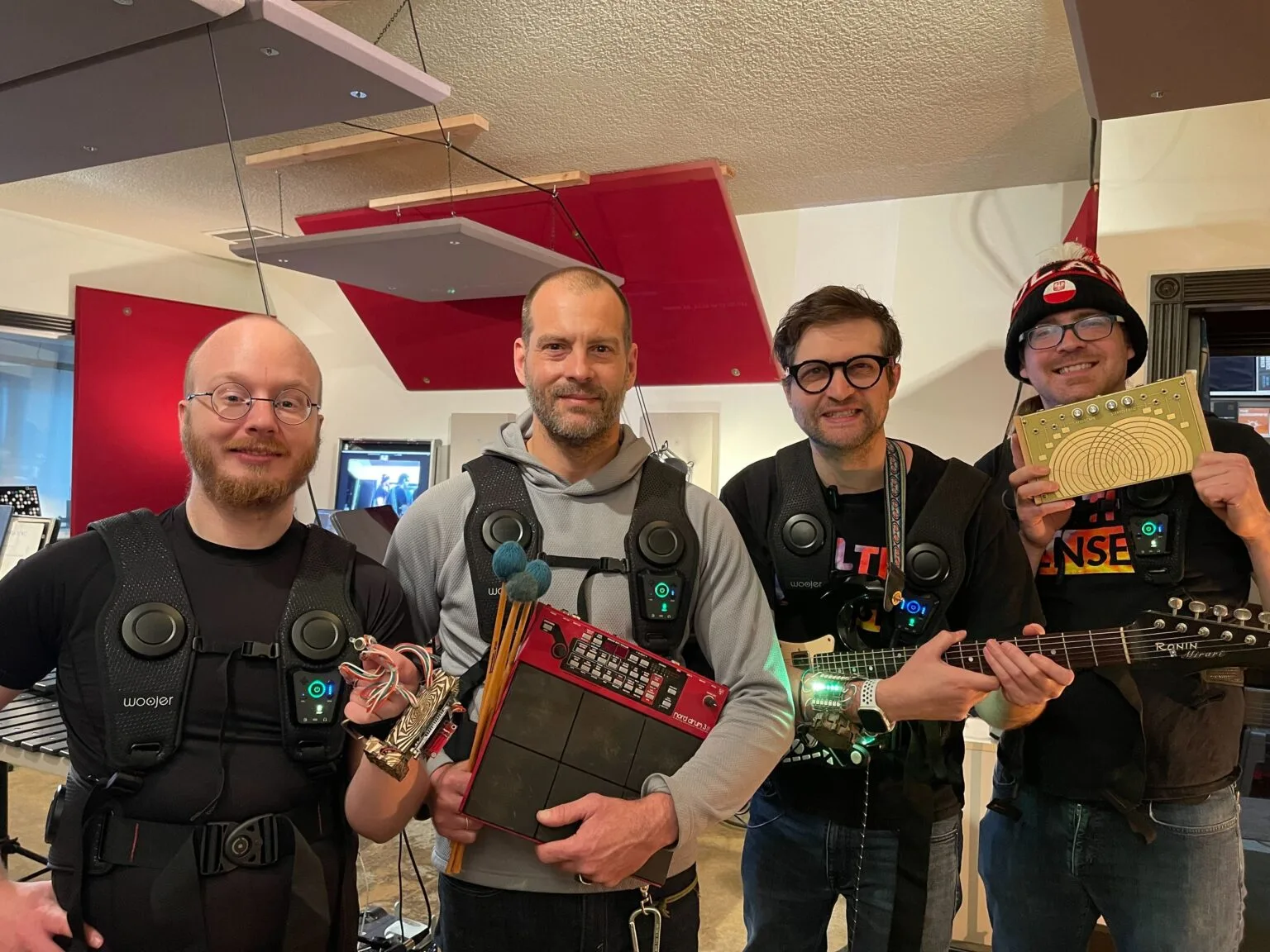
Figure 1. The Origin. Community members testing vibrating acoustic benches, early GELU bracers, and sound-reactive transducers during early tactile bench prototyping sessions in Portland with Universal Music Design.

THE ARCHITECTURE OF A TOURING ZOO: WHY PELICAN AIR CASES?

Touring an interactive electronic art exhibition across Oregon’s rural libraries, community centers, schools, and cultural venues presents unique mechanical and logistics challenges. Fragile one-off bench prototypes won't survive thousands of miles in transit or continuous hands-on interaction from enthusiastic visitors.

To solve this, our hardware R&D centers around Pelican Air cases as protective transport shells and modular station enclosures. These cases provide proven impact resistance, weather protection, and lightweight handling, giving us a durable foundation to iterate upon.

Our goal is to make setup as friction-free as possible for diverse host venues — designing toward quick-deployment enclosures, intuitive power options, and accessible touch surfaces that invite visitors of all ages and abilities to explore immediately.

Because this project is built openly at Control+H, we welcome maker creativity: whether prototyping custom internal sub-chassis, exploring rapid-disconnect wiring harnesses, or testing hot-swappable tactile mechanisms, the enclosure architecture is designed to evolve alongside the community’s best ideas.

⚡ Rapid Setup Goals

Designing toward intuitive, plug-and-play station setup that any venue host can manage.

🛡️ Transit Durability

Pelican Air shells protect sensitive electro-mechanical actuators during travel across Oregon.

🔧 Modular Serviceability

Encouraging easily serviceable sub-assemblies so stations stay active throughout the 2-year tour.

♿ Universal Ergonomics

Prioritizing accessible touch surfaces engineered comfortably for seated, standing, or wheelchair users.

FOUNDATIONAL MANIFESTO • OREGON COMMUNITY FOUNDATION

ORIGINAL LETTER OF INTENT: THE HAPTIC PETTING ZOO

Read the original proposal submitted for the OCF Creative Heights Grant. This document outlines the project’s radical transition from wearable assistive tools to autonomous bio-haptic sculptures, public makerspace residency, and statewide touring vision.

📄 Open Original Google Doc →

THE 5 FABRICATION TRACKS AT A GLANCE

TRACK 01

Industrial Design & Pelican Tour Packaging

PAID STIPEND

Explore durable enclosure design, internal structural chassis, custom protective foam inserts, and accessible tactile touch surfaces for our 5 touring Pelican Air cases.

Tools: CAD modeling, CNC routing, 3D printing, sheet metal fabrication.
TRACK 02

Modular STEM Mini-Zoo Desk Kits

LED BY DILLON (NEA SYNERGY)

Developing repeatable, classroom-ready desktop Mini-Zoo kits powered by HAXEL firmware with swappable motor weights and child-safe breakout boards. Directly links to our $100,000+ NEA Arts Education & Curriculum project in partnership with Columbia Regional Inclusive Services.

Focus: Open STEM hardware, educational curriculum integration, rapid kit assembly.
TRACK 03

Electronics, Driver Breakouts & Custom PCBs

PAID STIPEND

Design and fabricate custom tactile driver carrier boards, high-current MOSFET and H-bridge stages, and ESP32-S3 wireless nodes — building toward a Pixelblaze-style tactile engine (HapticBlaze).

Tools: EasyEDA / Open PCB software, SMT reflow, power distribution, thermal sinks.
TRACK 04

Firmware, Low-Latency ESP-NOW & DSP

PAID STIPEND

Optimize real-time C++/PlatformIO and MicroPython firmware. Build ultra-fast (<20ms latency) ESP-NOW wireless mesh synchronization, MIDI/I2S input processing, real-time audio FFT spectral bins, and tactile translation curves.

Tools: C++, PlatformIO, ESP32 FreeRTOS, digital signal processing, MIDI/I2S audio.
TRACK 05

Media, High-Speed Capture & ASL Video

CO-LED BY DILLON (ASL LEAD) & MAKERS

Capture the kinetic beauty of tactile motion! High-speed macro video (120–240fps) showing physical wave propagation, thermal imaging, comprehensive build logs, and native Deaf-led ASL educational videos.

Focus: High-speed macro videography, ASL translation, lighting, open documentation.
TRACK 01

Industrial Design & Pelican Tour Packaging

PAID STIPEND

Objective: Transform 5 Pelican Air 1615 cases into ruggedized, rapidly-deployable interactive stations capable of handling heavy daily public interaction across a 2-year statewide tour.

Core Areas of Exploration:
  • Chassis & Internal Mounting: Developing internal structural skeletons and custom-routed protective foam inserts for actuators and driver electronics.
  • Interactive Touch Surfaces: Designing ergonomic, durable top panels with safe, comfortable contact points for diverse visitors.
  • Harnessing & Strain Relief: Exploring robust quick-disconnect connectors and clean internal cable management.
  • Power & Safety: Integrating safe master power switches, circuit protection, and field-friendly power options.
CAD Modeling CNC Foam Routing 3D Printing Laser Cutting Sheet Metal
TRACK 02

Modular STEM Mini-Zoo Desk Kits

LED BY DILLON (NEA SYNERGY)

Objective: Create a desktop educational version of the Haptic Zoo tailored for K-12 classrooms, STEM workshops, and DHH students, synergized with our NEA Grant with Columbia Regional Inclusive Services.

Core Areas of Exploration:
  • Modular Swappable Heads: Quick-change motor heads with eccentric rotating masses of varying weights to demonstrate physical torque, resonance, and inertia.
  • Desk Enclosures: Stackable, durable child-safe housings with transparent viewports showing internal mechanical motion.
  • Sensor Breakouts: Plug-and-play sensor inputs (light, proximity, microphone) to demonstrate real-time cross-modal translation.
  • Classroom Curriculum Cards: Step-by-step experiment guides mapping tactile feedback to acoustics, physics, and human physiology.
Open-Source Hardware Classroom Ergonomics HAXEL Firmware Columbia Regional Collab
TRACK 03

Electronics, Driver Breakouts & Custom PCBs

PAID STIPEND

Objective: Design open-hardware carrier boards and power stages for driving diverse tactile actuators (solenoids, voice coils, transducers, Peltier thermal cells) — creating a Pixelblaze for haptics (HapticBlaze).

Core Areas of Exploration:
  • Actuator Driver Modules: High-efficiency MOSFET switch banks for solenoids and dual-direction H-bridges for thermoelectric Peltier cells.
  • ESP32 Micro-Carriers: Clean breakout boards for ESP32-S3/C3 modules with onboard level-shifting, I2C headers, and fused power inputs.
  • Thermal & Circuit Protection: Hardware safety cutoffs and PTC resettable fuses to prevent overheating or continuous solenoid hold.
  • Open Design Files: Complete schematics, gerbers, and BOMs developed in open PCB design software (EasyEDA / Open EDA).
EasyEDA / Open PCB Design SMT Assembly MOSFET / H-Bridge Stages Power Distribution
TRACK 04

Firmware, Low-Latency ESP-NOW & DSP

PAID STIPEND

Objective: Develop real-time, non-blocking embedded firmware powering the Haptic Zoo ecosystem, ensuring sub-20ms sensor-to-actuation latency and synchronized multi-station performance.

Core Areas of Exploration:
  • Audio DSP Pipeline: Real-time FFT analysis decomposing incoming audio into discrete low, mid, and high tactile frequency bands.
  • ESP-NOW Wireless Mesh: Fast point-to-multipoint wireless protocol broadcasting tactile triggers between stations in under 12ms.
  • Cross-Modal Mapping: Configurable logarithmic and perceptual mapping curves tailored to human mechanoreceptor sensitivity.
  • HAXEL Pattern Engine: Scriptable tactile waveform generator for custom percussive strikes, continuous buzzes, and thermal ramps.
C++ / PlatformIO ESP32 FreeRTOS ESP-NOW Wireless Audio FFT / DSP MIDI Processing
TRACK 05

Media, High-Speed Capture & ASL Video

CO-LED BY DILLON (ASL LEAD) & MAKERS

Objective: Document the full engineering process and create an accessible media library featuring high-speed macro video of tactile actuators in motion alongside native Deaf-led ASL educational content.

Core Areas of Exploration:
  • High-Speed Macro Videography: 120–240fps footage capturing physical vibration wave propagation, water droplet cymatic agitation, and solenoid impacts.
  • Native ASL Educational Videos: High-production ASL videos explaining the science of sound, touch, and the Haptic Zoo (led by Dillon).
  • Build Logs & Open Guides: Step-by-step photo manuals and interactive documentation for hackers and educators worldwide.
  • Press & Tour Media Kit: Broadcast-ready photo and video reels for media outlets, museums, and festival curators.
High-Speed Macro Video ASL Translation Open Hardware Wiki Studio Lighting & Audio

THE 4 MECHANORECEPTOR CHANNELS

1. Pacinian Corpuscles (200–300 Hz)

Deep skin receptors tuned to fine, high-frequency textures and micro-vibrations. Driven by Linear Resonant Actuators (LRAs) and precision voice coils. Feels like carbonated water or smooth electric buzzing.

2. Meissner’s Corpuscles (10–50 Hz)

Superficial skin receptors sensitive to dynamic low-frequency "flutter" and transient taps. Driven by Eccentric Rotating Masses (ERMs) and solenoids. Feels like tapping fingers, gentle thumps, or physical slip.

3. Merkel Disks (0.4–5 Hz / Static)

Sustained pressure and point-contact receptors. Driven by micro-servos, pneumatic bladders, and mechanical levers. Feels like squeezing, physical firmness, or spatial indentation.

4. Ruffini Endings (Continuous Stretch)

Sensitive to lateral skin stretch, warmth, and directional friction. Driven by rotating friction rollers and Peltier thermoelectric cells. Communicates weight, drag, and ambient temperature shifts.

✦ INTERACTIVE TACTILE FREQUENCY SIMULATOR ✦

Adjust the tactile frequency below to simulate which human mechanoreceptors are activated and see the resulting synthetic waveform:

Primary Receptor: Pacinian Corpuscles
Sensation: Fine buzzing / Carbonation / Shimmer
Hardware Target: LRA / Voice Coil / Tactile Transducer

✦ THE 20-MILLISECOND LATENCY BUDGET ✦

In psychoacoustics, tactile and audio feedback must occur within <20 milliseconds of an event for the human brain to fuse them into a single perceptual event. Delays exceeding 50ms destroy the illusion of touch. Our firmware utilizes bare-metal FreeRTOS queues on the ESP32-S3 and zero-overhead ESP-NOW packets to achieve round-trip latency under 12ms.

✦ HAXEL ENGINE: THE "WLED FOR HAPTICS" ARCHITECTURE ✦

At the core of the Haptic Petting Zoo is HAXEL (Haptic Pixel Engine)—open-source ESP32 firmware created by Dillon Simeone. Just as a pixel merges RGB values into one unit of visible light, a haxel collapses amplitude, carrier frequency, and transient phase into a single addressable unit of tactile sensation. Haxel serves as the unified firmware engine across all physical installations, suits, and workshop kits.

FREERTOS DUAL CORE
Core-Isolated DSP Engine

Core 0 processes 32-band real-time I2S FFT binning and envelope followers; Core 1 handles WebSocket telemetry and captive portal web hosting.

ZERO OVERHEAD
ESP-NOW Mesh Synchronization

Peer-to-peer wireless packet synchronization allowing multiple haptic suits, floorboards, and smart dials to pulse in sub-12ms lockstep.

HAL ENGINE
Universal Actuator Driver Abstraction

Abstraction layers across ERMs, LRAs, Solenoid Tappers, Peltier Cells, and Brushless Motor Detents without hardware register lock-in.

NO APP REQUIRED
Captive Portal Web IDE

Every ESP32 running Haxel broadcasts a mobile-first Web GUI with interactive visualizers, frequency sweepers, and pattern studio presets.

HAXEL TELEMETRY OSCILLOSCOPE SIMULATOR

DESKTOP TACTILE KITS FOR THE NEXT GENERATION

While the full-scale 10-station Haptic Petting Zoo tours museums, performing arts centers, and maker spaces, our team is developing a compact, modular STEM Mini-Zoo Kit designed specifically for schools, library makerspaces, and DHH youth classrooms.

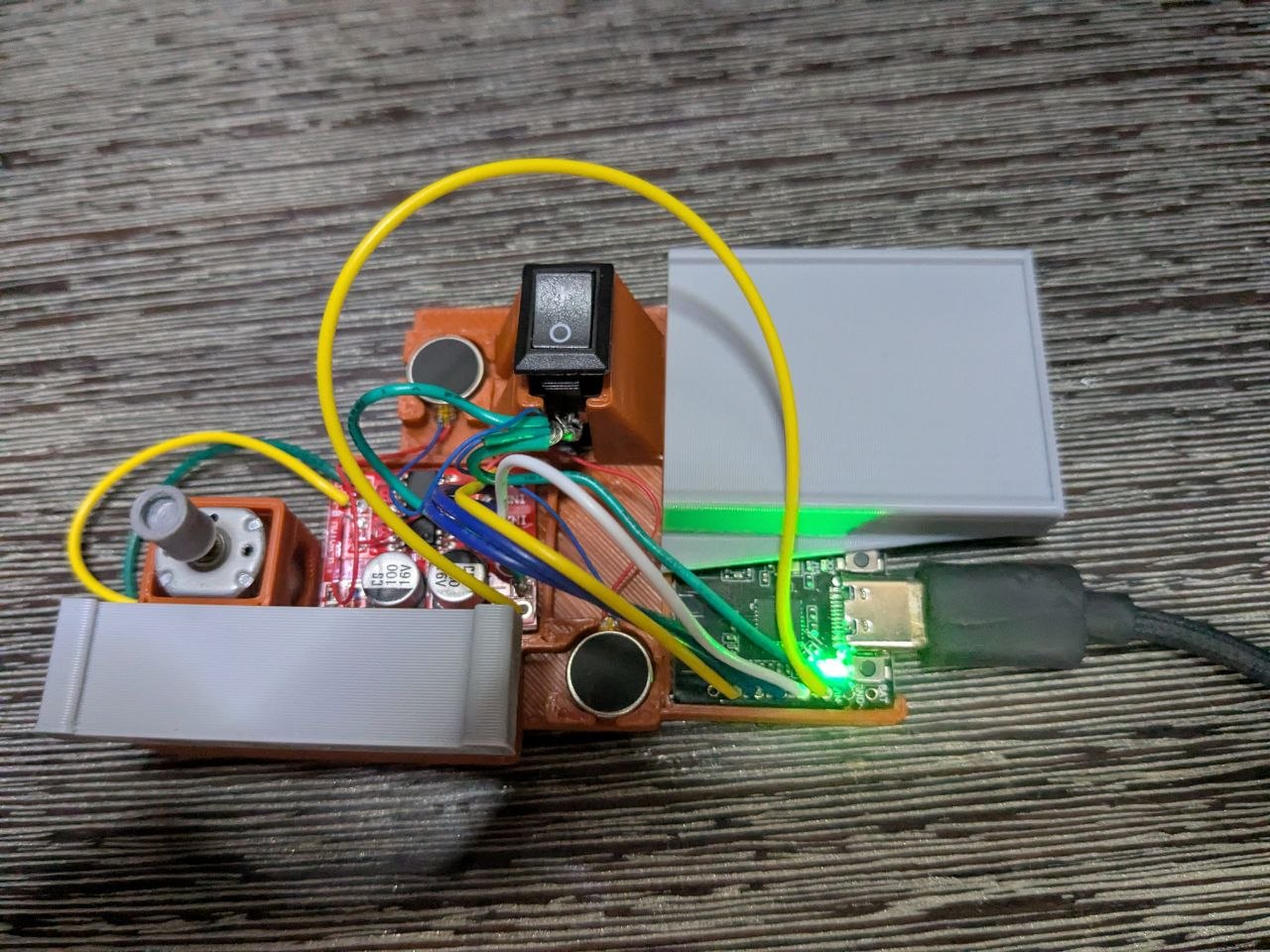
Each kit is powered by our open-source HAXEL firmware and features three swappable tactile elements with quick-release magnetic connectors, swappable eccentric weights, and child-safe low-voltage breakout drivers. Students can plug in audio jacks, light sensors, or distance probes to immediately feel real-time signal translation.

This initiative aligns seamlessly with our active National Endowment for the Arts (NEA) research proposal, conducted in partnership with Universal Music Design and Columbia Regional Inclusive Services. By standardizing the core hardware architecture across both grants, every dollar invested by OCF into hardware R&D serves as matching cost-share funds for federal STEAM education grants!

HAXEL Workshop STEM Kit

Figure 3. The HAXEL STEM Workshop Kit with swappable motor heads and USB-C tactile driver breakout.