MOTION-REACTIVE LIGHT BATON
Swing it, it vibrates and glows! A high-performance flow-arts and stage-performance kinetic instrument with 6-axis motion tracking, responsive haptic feedback, and universal parametric core fabrication.
Kinetic Action & Parametric Core Versatility
Watch the baton swing in real time; generating instantaneous vibration feedback and trailing LED light sweeps as velocity builds. Below it is the custom 3D parametric configurator that lets Dillon build this baton around any core material you choose.
Live Kinetic Swing Demo: Instantaneous haptics & glowing velocity trail
Built Around Any Core: Bamboo, Steel, or Branch
Most commercial LED flow props are glued into cheap, brittle plastic tubes. Dillon's parametric system treats the structural core as an open variable. By adjusting shaft diameters and wall offsets in code, the baton's 3D-printed chassis can clamp onto lightweight bamboo shafts, rigid solid steel rods, carbon fiber spars, or hand-foraged tree branches.
Launch Live 3D Parametric CAD Studio →Interactive Kinetic Motion Simulator
Drag your cursor across the canvas or trigger kinetic actions below to simulate swinging the baton. This interactive simulator runs the exact math from Dillon's ESP32 firmware: 6-axis MPU motion analysis, planar X/Y velocity gating, 5V vibration cell PWM drive with deadband clamping, and sub-10ms ESP-NOW wireless broadcast with delta-smoothed follower lighting.
Next-Gen Hardware Upgrade: Monolithic Reactive Controller PCBs
Prototype light batons relied on hand-wired perfboards and point-to-point silicone wiring squeezed into 3D-printed core sleds. To elevate the baton into a rugged, stage-ready instrument, Dillon designed and ordered a dedicated production batch of custom 2-layer SMT controller PCBs (JLCPCB fabricated). These boards eliminate rat's-nest wiring, eradicate parasitic battery sleep drain, and introduce dual independent 5V haptic channels.
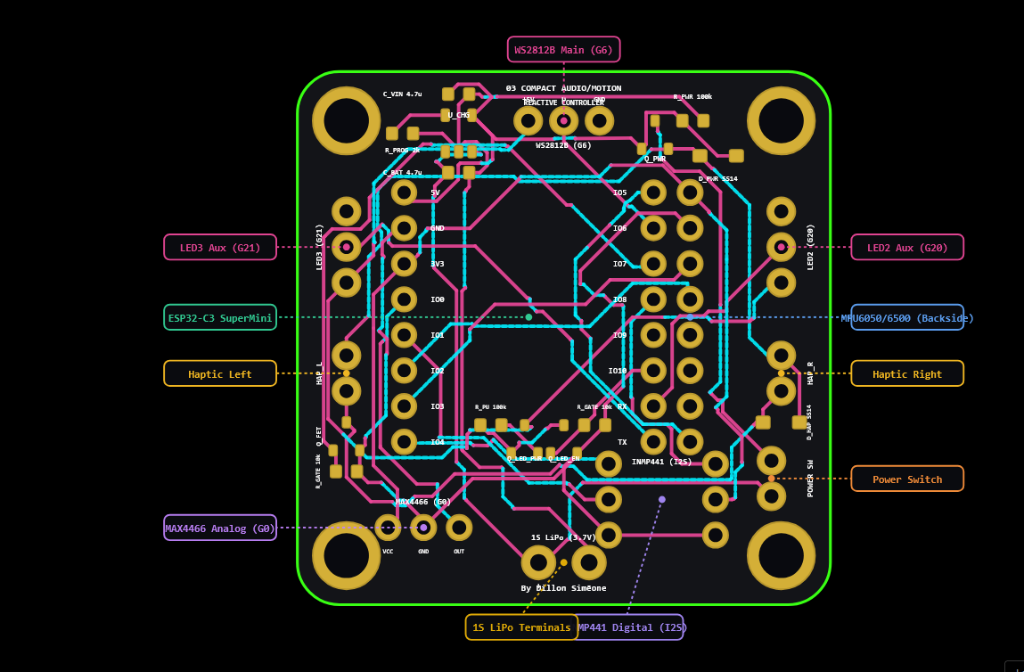
Production Gerber Layout: Back-to-back 3D stacked carrier with standard 31×31mm M3 bolt pattern
-
Back-to-Back 3D Component Stacking
The ESP32-C3 SuperMini MCU mounts on the top surface, while the MPU6050/6500 6-axis IMU mounts directly underneath on the bottom layer. This vertical stacking minimizes I2C trace lengths to under 6mm, isolates high-frequency radio noise, and fits comfortably inside narrow 38mm cylindrical handles.
-
Dual 5V Haptic Channels with Flyback Protection
Upgraded from a single motor to dual independent vibration channels (Haptic Left & Right). Driven by high-current AO3400A N-channel MOSFETs with 10k gate pull-downs and onboard SS14 Schottky flyback diodes (D_HAP), fully protecting the microcontroller from inductive motor voltage spikes during rapid kinetic swings.
-
Zero-Drain High-Side LED Isolation
Addressable WS2812B LED pixels continuously consume 1mA to 3mA per pixel even when turned black. A dedicated AO3401A P-channel MOSFET switch (Q_LED_PWR) completely severs 5V rail power to the strip during deep sleep, extending standby battery life from days to months.
-
TP4056 Charging with Auto Power-Path Switching
Features onboard TP4056 1S LiPo charging via USB-C (R_PROG configured for 500mA fast charge) coupled with an automatic P-FET power-path selector (Q_PWR + D_PWR). Performer batons seamlessly draw continuous power from external USB power banks without cycling or stressing the internal lithium cell.
-
Hybrid Audio + Kinetic Reactive Inputs
In addition to the 6-axis inertial tracking, the PCB integrates both an analog MAX4466 microphone (ADC1_CH0 / G0) for zero-latency kinetic audio beats and a digital I2S INMP441 microphone (BCLK, WS, SD) for studio-grade FFT frequency band analysis.
Remote Lighting Broadcast & Internal Core Architecture
The baton is an interactive controller as well as a kinetic prop. Below, watch the baton wirelessly trigger remote room lights over ESP-NOW, and examine the internal hardware core sled.
ESP-NOW Remote Lighting Trigger (Part 1)
Sub-10ms Wireless Room Lighting Sync (Part 2)
Internal Core Sled: 3D printed carrier & electronics
Hardware Architecture & Electronics Specifications
Engineered for extreme centrifugal force, rotational stability, and zero-latency wireless broadcast.
| Subsystem | Hardware Component | Bus / Protocol | Engineering Purpose |
|---|---|---|---|
| Motion Tracking | MPU6050 / MPU6500 6-Axis IMU | I2C (GPIO 8 / 9) | Captures rotational gyroscope velocity and multi-axis acceleration at 200 Hz with on-chip DLPF filtering. |
| Tactile Feedback | High-Torque ERM Motor + AO3400A Driver | Hardware PWM | Translates kinetic velocity and centrifugal load directly into physical vibration felt through the performer's grip. |
| Visual Illumination | High-Density WS2812B Addressable LED Strip | FastLED RMT | Trailing chromatic ripples, energetic wave bursts on strikes, and smooth delta-time easing. |
| Wireless Telemetry | ESP32-C3 SuperMini RISC-V | ESP-NOW Broadcast | Direct peer-to-peer radio packets broadcasted to stage lighting receivers with sub-10ms response time; no router required. |
| Power System | Rechargeable LiPo Cell + USB-C Charger | 5V Protected Bus | Integrated high-side MOSFET power-path isolation prevents LED parasitic battery drain when powered down. |
| Structural Chassis | Universal Parametric 3D-Printed Sled | Friction Clamp Collar | Clamps securely onto bamboo, steel, carbon fiber, or natural wood dowels based on performer balance preferences. |